Friday, 28 March 2014

Interviews with Mike Booth and Alex Harbord on Camera and Editing Techniques

Today I interviewed two of my lecturers, Mike Booth and Alex Harbord. Mike specialises in camerawork and sound and Alex specialises in editing. I asked them a couple of questions each in which will help me in my research for this blog.

Here is my interview with Mike Booth.


Here is my interview with Alex Harbord: Part 1.


Part 2.


Part 3.


Through having these interviews it has helped me understand things a lot clearer in the way action films are filmed and edited together. Through actually talking to people who specialise in these areas of expertise it has been far more use to me than reading a book or finding something off the internet as I feel that having a one to one conversation helps making things easier to understand and you can actually say if what they have said makes sense. Whereas when I have read a book or some information off a website it can be quite hard to understand what is being said as you can't simply ask them to elaborate on what they are talking about. Overall I would definitely recommend doing an interview as a way of research as it is more personal to you and will be far more helpful to you within your research. 

Friday, 14 March 2014

Different Methods of getting Crane Shots or Track and Dolly Shots

This week I researched into other methods of getting similar shots to what I've been talking about in my last 2 posts. I went to the library and found a book called 'Single-Camera Video Production', this was very helpful as it gave me more of an insight into what would be the best alternate route to go if you don't have access to equipment such as track and dollies and cranes.

These were some of the examples it gave:

  • Tri-pod on wheels (not a preferred method due to unstableness)
  • Wheel Chair
  • Car/Van (if you choose to do this I advise you let some air out of your tires which will absorb all the shock for you to get more of a steady performance handheld)
  • Boat
  • Airplane 
  • Helicopter 
  • Fork Lift
  • Elevator 
I experimented with what I had at home to create a Track and Dolly. I used my Skateboard and my Bike. Out of the two I though the Skateboard had a better effect as I could hold it with two hands to stabilise the camera where as with my bike it was quite difficult holding it with two hands and controlling the bike with my other hand at the same time. Overall if I were in need of using a Track and Dolly system I would most likely find a better way than both these two as both where quite unsteady, however the skateboard proved to be the better out of the two.

Here is the out come that I got:


As you can see in the list above that these are just a handful of alternative options you could go for if you wanted to get shots like these. Luckily for me when I filmed one of my recent projects I had access to the Jib arm and Track and Dolly. I only used the Jib for the final shot as I realised I didn't need the Track and Dolly for the shot that I was going to get.

This is an example of what the ending of my film looked like when using the Jib arm.


The reason I used the crane for this shot is because the whole film is about 'Don't judge a book by its cover' and here it shows the main character Kat who is quite a judgmental person rising as a new person after her judgmental encounter with a guy called Olli.

If any of you are interested in reading the book that I got out to research for this post this is the book you should look for, The Author is Robert B. Musburger. 


Wednesday, 5 March 2014

Equipment used to create shots part 2

In my last post I talked about the track and dolly system. I have carried on my research and instead of talking more about the track and dolly system I will be talking about the use of Cranes and Jib arms. This is yet again the sort of equipment that should only be used if necessary as the shots it will create can seem pointless and not pushing the story of your film forward, when creating a film you must always make sure that each shot is making your films story progress further.

I've been looking at a few films and their use of crane shots. The three films I have looked at is 'The Lord of The Rings - The Two Towers and Return of The King' and 'Batman - The Dark Knight'. Even though these crane shots don't last for very long they are very effective.


With the use of these crane shots in both 'The Lord of the Rings' films its use is to show the audience where they are, such as for the Two Towers end scene it is rising above the trees to show how close Frodo and Sam are to finishing their quest. In the Return of the King it is to simply show where Aragon and the rest of the crew are. The first shot is of them walking through the woods but until the shot rises up you do not know that they are actually in Isengard. Not only are these shots very aesthetically pleasing, they are also great in showing the audience rather than telling them. By doing this it lets the audience use their imaginations especially for the Two Towers as it makes the audience think 'why didn't Gollum take Frodo and Sam over the mountain' or 'What will Frodo and Sam encounter in Mordoor'.


In this end shot from 'Batman - The Dark Knight' it is just a small simple message. As the Joker rides off in the school bus and the camera rises above (with use of a crane) it is a metaphor for the rise of the Joker, showing that the bank robbery was just the beginning of his destruction towards Gotham city and is just a simple message to Gotham city that, that was just the beginning.

When I researched into track and dolly shots I also researched crane and jib arm shots in which was also included in our lesson on them the other week. These are some of the examples of what we did last week.


Through doing these sessions on this type of equipment it has helped in my understanding of the use that this equipment has in creating different types of shots. It was also nice to be using different equipment that we had never used before as it has given me more information of how to use it all and when to use it in shots.

Friday, 21 February 2014

Equipment used to create shots

In this post I will be talking about track and dolly shots. I think that this piece of equipment when used create some really good shots that look amazing when put into a final film. Although I think that when it is used it should only be used when necessary as it can be quite obvious that it has been used for the wrong reasons.

I recently watched Saving Private Ryan which I thought was such an amazing film and was a great example to use to talk about what an effective track and dolly shot looks like within an action film such as Saving Private Ryan. Within the first 15 minutes of the film you see a variation of shots, some being the track and dolly shots. Cutting to and from the tracking shots with a mixture of quick cuts in between   makes this first opening scene really effective as you are not bored by just one massive long tracking shot (Although in some cases long lasting tracking shots can be effective). Here I have edited together an example of the track and dolly shots in the opening sequence to Saving Private Ryan.


Here is a link to the full opening Scene if you are interested in watching it and seeing how effective it is with cuts in between the track and dolly shots.


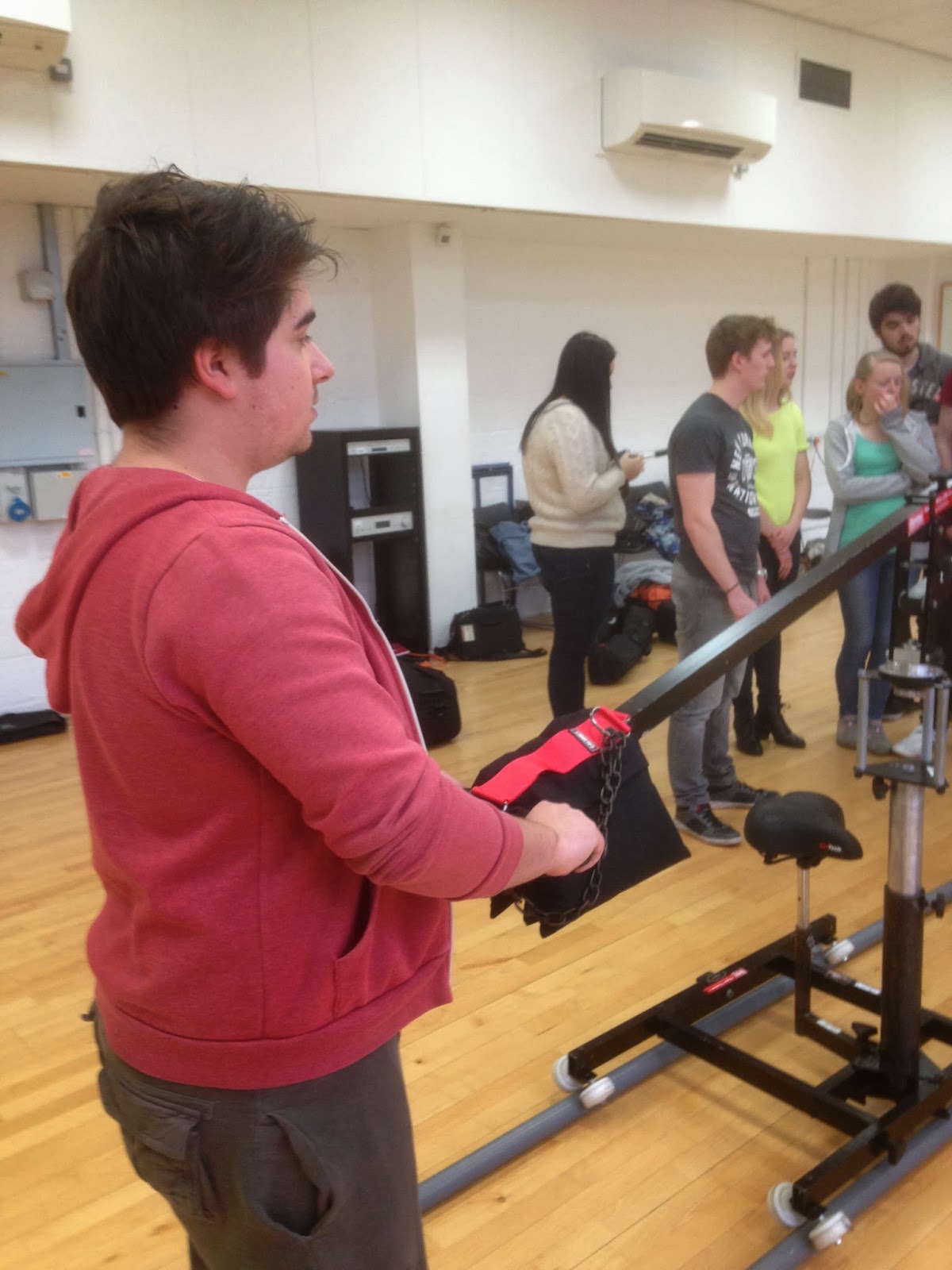
After wanting to research more on these track and dolly shots and how to use the equipment I had a lecture on how to use it and got the chance to have a play around with the equipment and practice different types of shots such as the vertigo effect and tracking shots. Here are some videos and pictures to show you what me and my lecture group got up to.


This video is a mixture of the vertigo shots and the tracking shots we did.


From doing this lecture and learning how to use the track and dolly it has given me more of an understand of various way to capture different motion shots. It has also given me the chance to use this equipment in future projects that I may be involved in.

Monday, 3 February 2014

My Own Example of Work

In my previous post I talked about camera angles and editing techniques on how to make an effective car chase sequence. This is a clip from some previous work where I filmed someone going down a hill on their bike. When it came to filming it I tried to use as many different angles as possible to get a variation of shots, rather than just simply filming someone going down a hill and getting no variation of footage at all. When I edited it together I made some of the clips last for as little time possible just to create a similar effect that the car chases in my previous post do.


Thursday, 30 January 2014

Chase scenes

I have been looking at a few chase scenes to see how fast the cuts are and what sort of camera angles are used to create the suspense of 'what's going to happen? Will they escape?'. Two chase scenes that caught my attention were one of the chase scenes in Drive and the opening sequence to Quantum of Solace. Both are very similar in the techniques they use such as close up camera angles and quick cuts but Drive seems to have less quick cuts between each shot compared to the quantum of solace. Each of these films have used two different types of techniques to create suspense for the viewers. Drive has more mid shots, which give the audience the chance to see more of the surroundings such as a sharp bend. This helps create the tension of not knowing what will be around the corner. Drive also has more cuts to close ups on Ryan Gosling's face in which he has quite a neutral expression. This telling the audience that he's not afraid and is confident that he can loose the people chasing him.


Compared to the chase scene in Drive, Quantum of Solace chase scene is more up beat and feels more action packed. To get this sort of effect all the camera angles are mostly all close ups mainly focusing on the cars, cutting between shots of each car and going from close ups of the bonnet to the wheels of the car to an extreme close up of Bonds eye then to guns getting loaded. Through the camerawork and the editing it has all been combined to create and tell the audience that something bad is about to happen. After these few cuts which last around a second each, from then on its just constant cutting between different shots mostly close ups but every now and then going to mid shots of people firing guns.


Through reading about different camera and editing techniques on Chase scenes this website helped me understand more clearly as to what makes a good action chase scene. It was very clear on the process of creating a great action sequence for a chase scene.

http://www.videomaker.com/article/13484-dynamic-chase-scenes

This diagram is also a great example of what sort of shot you want to be getting and cutting between. It will then just be a case of finding the right music and cutting at the right times to the right shots to create the perfect chase sequence.


Monday, 20 January 2014

Introduction

I am a media production student at Northumbria University. Within this project I will be researching into the camera techniques in Action cinema. I will be looking into the different types of camera angles within different action sequences, researching into why they are so effective at creating suspense and dominance within the characters and within the action sequence in general.

I will start this by showing you one of my favourite action films, Rambo. I like this film so much because it has suspense though out the film. The fact that it is one man against a whole town of police officers. Even in the trailer you feel that suspense of wanting to go watch it. The trailer for this film has been made so well as it shows quick cuts of action whilst a voice over of Colonel Trautman saying 'Teasle, you and all your men couldn't handle him before now what makes you think you can handle him no, because god knows what damage he's prepared to do now' through having this over cuts of Rambo running through the town and shooting machine guns it already creates the effect of what will happen next. Out of the whole film I feel that the forest hunt scene where Rambo is taking down the officers one by one is the most effective as it has tense music and many different camera angles to differentiate who is in control.

Here is the trailer to Rambo: First Blood